


Thatcher - The Major New Biography
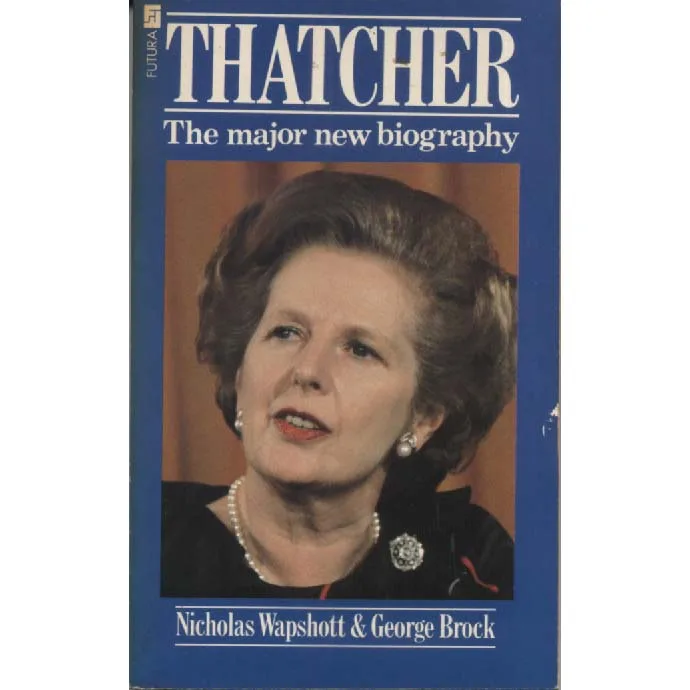
Publisher: Futura
Format: Paperback
ISBN: 9780708824337
Thatcher – The Major New Biography (1983) – Nicholas Wapshott and George Brock
Futura | ISBN: 9780708824337 | Condition: Good
Sold by Crappy Old Books – Where the Iron Lady Meets the Paperback Shelf, and the Only Thing Not for Sale Is the Family Silver.
There are politicians who enter office promising to change the country, politicians who spend their careers trying not to change anything whatsoever, and then there was Margaret Thatcher, who appeared to regard the entire British post-war settlement as an unfortunate administrative error requiring immediate correction.
By 1983, Britain had undergone four extraordinary years under its first female Prime Minister. Industries were struggling, unemployment had soared, trade unions were increasingly under pressure, the Falklands had been fought over, and an entire nation was discovering that the lady in Downing Street possessed considerably more determination than the gentlemen who had preceded her.
Into this atmosphere arrived Nicholas Wapshott and George Brock with Thatcher – The Major New Biography, a substantial examination of the woman who had already become one of the most divisive figures in modern British politics.
Published by Futura in 1983, this biography offers something particularly valuable: a portrait of Thatcher written while her premiership was still unfolding, before the miners’ strike, before the Poll Tax, before the Brighton bombing, before the final Downing Street tears, and long before historians had finished arguing about whether she had rescued Britain, ruined it, or somehow managed both simultaneously.
It is Thatcher captured in the early years of Thatcherism, when the ideological revolution was still gathering momentum and the consequences were only beginning to emerge.
Born Margaret Roberts in Grantham in 1925, the future Prime Minister was the daughter of a grocer, a fact that would become almost as important to her political mythology as the Battle of Waterloo was to Wellington. Her upbringing above the family shop, her Methodist background, her education at Oxford and her subsequent career in law and politics all contributed to the formation of a woman whose belief in discipline, hard work and individual responsibility would eventually reshape British political debate.
Few other politicians have managed to turn the operation of a provincial grocery business into a comprehensive philosophy of national government.
Thatcher’s ascent was remarkable. Entering Parliament as Conservative MP for Finchley in 1959, she progressed through ministerial office before becoming leader of the Conservative Party in 1975, defeating Edward Heath in a contest that demonstrated that the Conservative establishment was not quite as secure in its own assumptions as it had imagined.
Four years later, following the industrial disruption and political disillusionment of the Winter of Discontent, she entered Number 10 Downing Street.
Britain had acquired its first female Prime Minister.
Unfortunately for anyone expecting a soothing maternal presence, she had not come to tuck the country into bed and read it a story.
Wapshott and Brock examine Thatcher’s personality, political development, ambitions and the circumstances that propelled her into power. Their biography explores the public figure and the private individual, tracing the combination of intellectual conviction, political calculation and formidable personal determination that helped transform an ambitious Conservative politician into a national phenomenon.
The early Thatcher years provide especially fascinating material. Her government embraced monetarist economic policies, challenged established approaches to public spending and industrial management, and rejected the political compromises that had shaped much of the post-war consensus.
For supporters, this represented a long-overdue confrontation with Britain’s economic decline.
For opponents, it resembled an experiment in determining how much unemployment, industrial disruption and social upheaval a country could endure before somebody noticed that the medicine was making the patient decidedly uncomfortable.
Thatcher, naturally, was not inclined to abandon the prescription.
Then came 1982 and the Falklands War, an event that dramatically transformed her political standing. Argentina’s invasion of the islands prompted a British military response that culminated in their recapture, producing a surge of national confidence and strengthening Thatcher’s reputation for decisiveness.
The victory helped establish the image of the Iron Lady as a leader who would not readily retreat, compromise or accept defeat.
It also provided newspaper editors with an almost inexhaustible supply of opportunities to describe her as formidable.
By the 1983 general election, Thatcher had become the dominant personality in British politics. The Conservatives secured a commanding parliamentary majority, while Labour struggled under Michael Foot and the newly formed SDP–Liberal Alliance divided much of the opposition vote.
To her admirers, she was the woman who had restored confidence and direction to a country seemingly trapped in decline. To her critics, she was dismantling the institutions, industries and social arrangements upon which much of twentieth-century Britain had been built.
Both camps could at least agree that she was extremely unlikely to change her mind merely because someone had written a strongly worded letter.
What makes this particular biography appealing today is its contemporary perspective. Written in 1983, it does not enjoy the comfortable hindsight of later accounts, which can trace Thatcher’s premiership through the great confrontations and political crises of the following decade.
Instead, it captures a political career at an extraordinary moment of apparent triumph, when the future remained uncertain and the eventual scale of Thatcher’s influence was not yet fully understood.
There is something rather fascinating about reading a biography of a major historical figure written before the history has finished happening.
It is rather like reading a detailed assessment of the Titanic’s engineering achievements while the ship is still travelling confidently across the Atlantic.
Of course, Thatcher’s supporters and detractors will approach the book with different expectations. Admirers may find much to appreciate in the account of her determination, political courage and extraordinary rise through a traditionally male political establishment. Critics may be more interested in the ideological convictions, confrontational instincts and economic decisions that generated such fierce opposition.
Readers interested simply in political biography will find a portrait of a remarkable individual who refused to conform to established expectations and whose influence extended far beyond the Conservative Party.
Condition: Good. This is a previously owned copy of the 1983 Futura edition, showing the ordinary signs of age and handling consistent with its condition. It is a respectable vintage paperback from a period when British politics was loud, confrontational and frequently conducted by people wearing alarmingly large spectacles.
For collectors of political biographies, students of modern British history, Thatcher enthusiasts, Thatcher critics and anyone fascinated by the transformation of Britain during the 1980s, this is an intriguing contemporary account of a Prime Minister whose name became an ideology.
Available from Crappy Old Books, where we believe in allowing the market to determine the price, although we have yet to privatise the bookshelf.
Whether you regard Margaret Thatcher as the saviour of Britain, the architect of its industrial destruction, or simply the most formidable woman ever to confront a roomful of nervous Cabinet ministers, this biography offers an absorbing glimpse of the Iron Lady at the height of her early political ascendancy.
And unlike Mrs Thatcher herself, this particular copy is available second-hand.
One suspects she would have approved of the enterprise, if not necessarily the name of the bookseller.
Keep browsing: See more Politics books Other books by Nicholas Wapshott and George Brock
